20 Business Ideas That Solve Real Problems (Backed by 1M+ Complaints)
Most people start with an idea and then go looking for a problem. That is backwards. The founders who actually make money do the opposite: they start with a real, validated problem and build the simplest thing that solves it. If you need help figuring out how to validate your startup idea, start there before picking from this list.
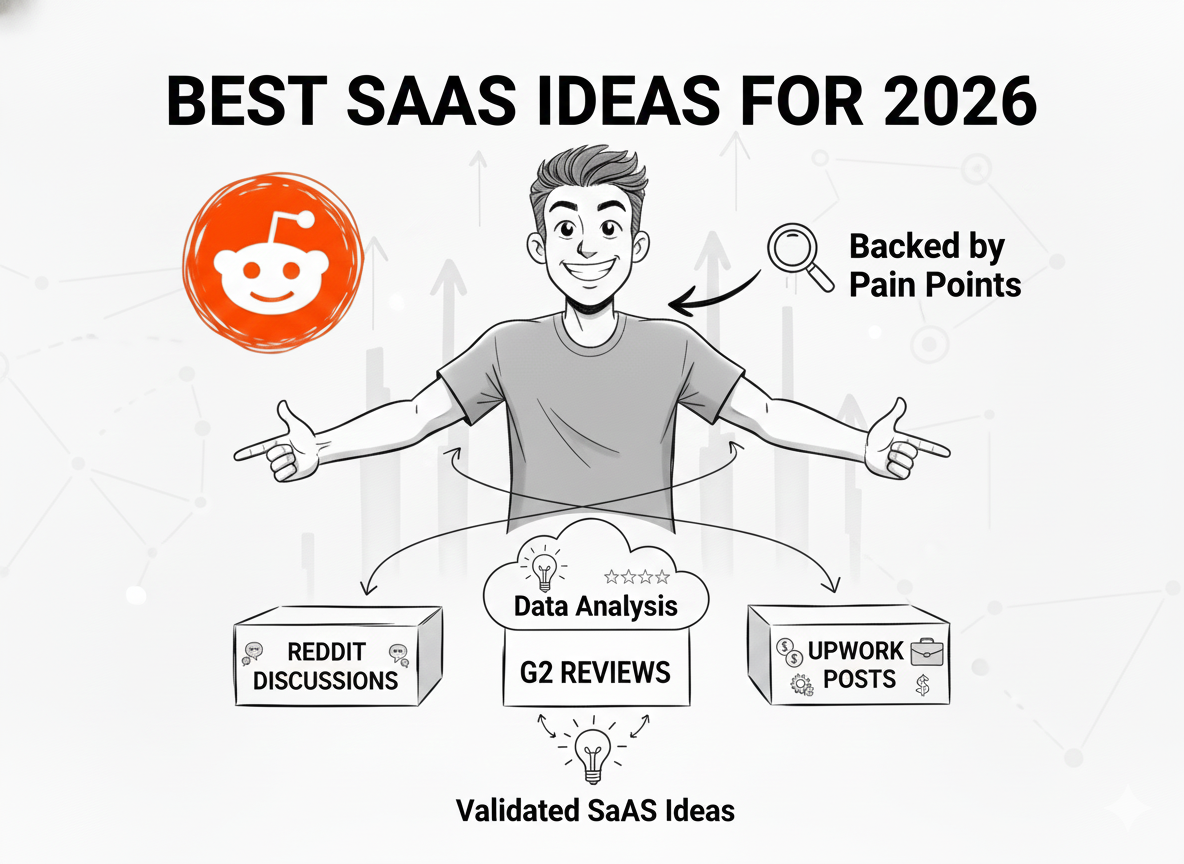
We used BigIdeasDB to analyze 1M+ real complaints from Reddit, G2, Capterra, app stores, and Upwork. Instead of guessing what people might want, we read what they are actually frustrated about — and pulled out 20 business ideas that solve problems people are already begging someone to fix. Every idea below includes a real user quote, a concrete solution approach, and an estimated market size.
If you are looking for business ideas that solve problems, this list is your starting point. Not brainstorming. Not guessing. Data.
Table of Contents
Healthcare
- Medical bill negotiation platform
- Mental health matching engine
- Chronic condition management hub
Small Business Operations
- Contractor invoicing & payment tool
- Small business compliance assistant
- Multi-location scheduling platform
Remote Work
- Async video update tool
- Remote team culture platform
- Focus time protector
Personal Finance
- Subscription cancellation manager
- Freelancer tax automation
- Couples financial planning app
Education
- Parent-teacher communication hub
- Skill gap analyzer for career changers
Real Estate
- Tenant maintenance request tracker
- First-time homebuyer navigator
Food & Sustainability
- Household food waste reducer
- Local farm-to-table marketplace
Developer Tools
- API documentation generator
- Dependency update manager
Find Your Own Problem-Solving Business Idea
BigIdeasDB is the only AI-powered platform that analyzes 1M+ real complaints from Reddit, G2, Capterra, and app stores. Browse thousands of validated problems filtered by category, severity, and market opportunity — so you can build something people actually want.
Explore BigIdeasDBWhat Problems Are People Paying to Solve Right Now?
Right now, people pay to escape service failures and pricing traps, not to fix bad interfaces. Across 39,000+ documented complaints about business software, customer service problems carry a churn signal 98% of the time and pricing problems 93% of the time, while user-experience complaints are the single most common category and carry one 67% of the time. The loudest complaint is not the one people pay to escape.
This is the question worth asking before you pick an idea, and it is answerable rather than a matter of opinion. We grouped 39,000+ complaints by type, then measured how often each type came attached to a churn signal, meaning the reviewer said they were leaving or wanted to. A complaint that makes someone leave is a complaint they will pay someone else to solve.
| Problem type | Documented complaints | Carries a churn signal | Read as |
|---|---|---|---|
| Customer service | 920+ | 98.2% | Highest willingness to switch |
| Customer support | 1,000+ | 96.7% | Same story, post-purchase |
| Pricing | 600+ | 93.4% | Priced-out buyers are a market |
| Integration problems | 430+ | 87.2% | Broken workflows get replaced |
| Performance | 730+ | 80.2% | Slow software loses accounts |
| Reporting | 780+ | 74.8% | Cannot get their own data out |
| User experience | 5,000+ | 67.5% | Most complained about, rarely fatal |
| Missing features | 910+ | 57.4% | Lowest. People ask, then stay |
Source: BigIdeasDB, 39,000+ documented software complaints grouped by type, categories with 300+ complaints shown. Snapshot July 2026. Near-duplicate source labels are reported separately rather than merged, so treat these as tiers rather than exact ranks.
The bottom row is the uncomfortable one. Missing features carry the lowest churn signal of any category at 57.4%. People ask for features and then stay anyway. Building the thing everyone is requesting is the most obvious move and the least correlated with someone actually leaving a competitor to pay you.
"Once you buy the software, you're on your own. If you run into the simplest obstacle, no one is there to support you." — Capterra review, healthcare CEO
There is a second, harder kind of evidence for what people pay to solve: what they already hire humans to do by hand. Across 5,000+ paid freelance job posts, the problems that recur most are manual rendering work, lead generation, portfolio and presentation production, bookkeeping reconciliation, inventory management, appointment scheduling and legal document preparation. When someone pays a person to do a job every month, willingness to pay has stopped being a hypothesis. We walk through that method in validating demand with freelance job data.
"Someone must have already built this. I'd happily pay for a tested solution rather than spend days reinventing the wheel." — r/automation
One caution before you act on any of it. Willingness to pay is not the same as willingness to pay much. Across the 3,700+ startups we track that report revenue, median monthly revenue is $145 and 76.4% earn under $1,000 a month. The problems below are real and people do pay to solve them. Size the business honestly against those revenue benchmarks rather than against the outlier you read about.
How We Found These Problems
We did not sit in a room and brainstorm. We built BigIdeasDB to do something no human could: read and categorize 1M+ complaints from across the internet. Our sources include Reddit threads, G2 and Capterra software reviews, app store reviews, Upwork job postings, and niche community forums.
For each problem below, we looked for three signals: frequency (how often people complain about it), intensity (how frustrated they sound), and willingness to pay (are people already spending money on bad solutions). The 20 ideas in this list scored highest on all three. These are not shower thoughts. These are problem-solving business ideas grounded in real demand. To learn from founders who skipped this step, read about failed business ideas and what they got wrong.
Healthcare
1. Medical Bill Negotiation Platform
The problem: Patients receive surprise medical bills, have no idea what they should actually owe, and lack the knowledge or leverage to negotiate. Insurance explanations are deliberately confusing.
“Got a $4,200 bill for an ER visit where I sat in the waiting room for 3 hours and saw a doctor for 8 minutes. My insurance ‘covered’ it but I still owe $1,900. I have no idea if that is correct and no way to find out.” — r/personalfinance
Solution approach: An AI-powered platform that scans medical bills for errors, compares charges against fair market rates, and either automates negotiation letters or connects patients with negotiators on a success-fee basis.
Estimated market: $4.7B (U.S. medical billing advocacy and patient financial services)
2. Mental Health Matching Engine
The problem: Finding the right therapist is brutally difficult. Insurance directories are outdated, waitlists are months long, and most people give up after calling three offices with no availability.
“I have been trying to find a therapist who takes my insurance and specializes in ADHD for 6 weeks. I have called 22 offices. 14 were not accepting patients, 5 did not return my call, and 3 had a 4-month wait. I just wanted help.” — r/ADHD
Solution approach: A real-time availability matching engine that verifies insurance acceptance, specialty fit, and current openings. Therapists update availability weekly via a simple dashboard. Revenue comes from booking fees or a SaaS model for practices.
Estimated market: $6.1B (digital mental health platforms, U.S.)
3. Chronic Condition Management Hub
The problem: People with chronic conditions like diabetes, Crohn’s, or autoimmune disorders juggle multiple doctors, medications, lab results, and dietary requirements — across apps that do not talk to each other.
“I have Type 1 diabetes, hypothyroidism, and celiac. I use three separate apps to track blood sugar, meds, and food. None of them share data. Every doctor appointment I bring a folder of screenshots.” — r/diabetes
Solution approach: A unified dashboard that aggregates data from glucose monitors, medication trackers, lab portals, and food diaries. AI flags concerning trends and generates one-page summaries for doctor visits.
Estimated market: $12.3B (chronic disease management software, global)
We ranked the 10 strongest problem-solving app ideas from this same complaint data on video, with the severity and market-gap score behind each one:
Small Business Operations
4. Contractor Invoicing & Payment Tool
The problem: Independent contractors and tradespeople lose thousands of dollars a year to late payments, forgotten invoices, and clients who ghost. Existing invoicing tools are built for desk workers, not someone on a job site. This is just one of many B2B business ideas hiding in plain sight.
“I am a plumber. I did $3,800 worth of work last month and only got paid for $2,100 because I forgot to send two invoices and one client is ‘waiting on a check.’ I do not have time to chase people down between jobs.” — r/smallbusiness
Solution approach: A mobile-first invoicing app with photo-based job logging, automatic payment reminders, and built-in payment processing. Voice-to-invoice for hands-free entry on job sites.
Estimated market: $3.9B (small business invoicing software)
5. Small Business Compliance Assistant
The problem: Small business owners are expected to track tax deadlines, labor laws, permits, and regulatory changes across city, state, and federal levels — and they get fined when they miss something nobody told them about.
“I just got a $2,500 fine because apparently my city changed the food handler permit renewal process 6 months ago and I missed the email. There is no centralized place to track this stuff.” — r/restaurateur
Solution approach: An AI compliance tracker that monitors regulatory changes at every level based on your business type and location. Sends proactive alerts, generates checklists, and pre-fills renewal forms.
Estimated market: $5.2B (regulatory compliance software for SMBs)
6. Multi-Location Scheduling Platform
The problem: Businesses with multiple locations (salons, clinics, cleaning services) struggle to manage staff schedules, client bookings, and resource allocation across sites. Most tools only handle one location well.
“I run three nail salons. My staff float between locations. I spend 5 hours every Sunday on spreadsheets trying to build next week’s schedule. Every scheduling app I have tried is designed for a single shop.” — r/sweatystartup
Solution approach: A scheduling platform built for multi-location operations with staff sharing, demand-based shift optimization, and client booking across any location. AI suggests optimal staffing based on historical demand patterns.
Estimated market: $4.1B (workforce scheduling software)
Remote Work
7. Async Video Update Tool
The problem: Remote teams hold too many meetings that could be async updates. Existing tools like Loom are good for one-off recordings but lack the structure for recurring team updates, threading, and follow-ups.
“We have a 30 minute daily standup with 12 people. 10 of those people just say ‘still working on the same thing.’ That is 5 hours of collective time wasted every day. We tried Loom but there is no structure or follow-up.” — r/remotework
Solution approach: Structured async video updates with templates (standup, weekly recap, sprint review), threaded responses, AI summaries, and automatic highlights. Managers see a dashboard of team updates without scheduling a single meeting.
Estimated market: $2.8B (async collaboration tools)
8. Remote Team Culture Platform
The problem: Remote workers report feeling isolated and disconnected from their teams. Managers have no visibility into morale until someone quits. Slack channels for “water cooler chat” go dead within a week.
“I have been remote for 2 years and I genuinely do not know what half my coworkers look like. We have a #random channel that nobody posts in. I like the flexibility but I feel like a contractor, not a team member.” — r/experienceddevs
Solution approach: A lightweight platform that automates social connection through randomized virtual coffee pairings, team pulse surveys, recognition feeds, and shared interest groups. AI detects declining engagement and nudges managers before burnout happens.
Estimated market: $1.9B (employee engagement platforms)
9. Focus Time Protector
The problem: Knowledge workers are interrupted every 11 minutes on average. Calendar apps let anyone book your time. Slack pings constantly. Deep work is nearly impossible without heroic self-discipline.
“I blocked 2 hours for deep work. In those 2 hours I got 14 Slack messages, 3 meeting invites, and a ‘quick call’ request. I accomplished nothing. My calendar means nothing to anyone.” — r/productivity
Solution approach: An app that enforces focus blocks by auto-declining meeting invites during deep work, batching Slack notifications, and sending an auto-reply with your availability. Integrates with Google Calendar, Slack, and Teams. Analytics show managers how much focus time their team actually gets.
Estimated market: $1.4B (productivity and focus software)
Personal Finance
10. Subscription Cancellation Manager
The problem: The average American spends $273/month on subscriptions and underestimates their total by 2.5x. Companies make cancellation deliberately hard with dark patterns, phone-only cancellation, and retention mazes.
“I just audited my subscriptions. I was paying for 14 services totaling $387/month. Three of them I had completely forgotten about. One required a PHONE CALL to cancel and put me on hold for 40 minutes.” — r/Frugal
Solution approach: A tool that scans bank statements for recurring charges, identifies unused subscriptions, and handles cancellation on your behalf — including the ones that require phone calls. Revenue model: percentage of money saved or flat monthly fee.
Estimated market: $3.2B (subscription management and personal finance tools)
11. Freelancer Tax Automation
The problem: Freelancers and gig workers are terrible at setting aside money for taxes because income is irregular. Most find out they owe thousands in April. Existing tax software is designed for W-2 employees.
“First year freelancing. Just found out I owe $8,400 in taxes. Nobody told me about quarterly estimates. I have $900 in savings. I am genuinely panicking.” — r/freelance
Solution approach: An app that connects to bank accounts, automatically categorizes income by client, calculates quarterly tax obligations in real-time, and auto-transfers the right percentage to a tax savings account. Sends quarterly filing reminders with pre-filled forms.
Estimated market: $2.6B (freelancer financial tools)
12. Couples Financial Planning App
The problem: Money is the number one cause of relationship stress, but most budgeting apps are built for individuals. Couples need shared visibility, joint goal tracking, and a way to split expenses that does not start a fight.
“My partner and I make different salaries but split rent 50/50 which feels unfair to me. We tried YNAB but it is designed for one person. We need something that handles proportional splitting and shared goals without me having to build a spreadsheet.” — r/relationships
Solution approach: A financial planning app built for two. Supports proportional expense splitting, shared savings goals, individual discretionary budgets, and transparent dashboards. AI suggests fair splits based on income ratio and spending patterns.
Estimated market: $1.8B (personal finance apps, couples segment)
Education
13. Parent-Teacher Communication Hub
The problem: Parents juggle ClassDojo, Remind, email, paper flyers, and text messages from different teachers. Important information gets lost. Teachers spend hours repeating the same updates across channels.
“I have 2 kids in elementary school. I have to check 4 different apps, email, and a physical folder every day to make sure I do not miss picture day or a permission slip. My kid missed a field trip because the reminder was in ClassDojo and I only checked Remind that week.” — r/Parenting
Solution approach: A single hub that aggregates all school communications into one feed per child. Teachers post once and it pushes everywhere. AI prioritizes action-required items and sends deadline reminders.
Estimated market: $2.1B (K-12 communication platforms)
14. Skill Gap Analyzer for Career Changers
The problem: People who want to change careers have no idea what skills they actually need, which ones they already have, and what the fastest path is. Career advice online is generic and outdated.
“I am a teacher wanting to move into UX design. Every article says ‘learn Figma and build a portfolio’ but I have no idea if my 8 years of curriculum design counts for anything or how long this transition will realistically take.” — r/careerguidance
Solution approach: An AI tool that maps your current skills to target roles using real job posting data. Shows exactly which skills transfer, which ones you need to learn, and recommends the most efficient learning path. Tracks progress and tells you when your profile matches entry-level requirements.
Estimated market: $3.4B (career development and upskilling platforms)
Real Estate
15. Tenant Maintenance Request Tracker
The problem: Renters submit maintenance requests that disappear into a void. Landlords lose track of requests across multiple properties. Both sides have no visibility into status, and disputes over response times are constant.
“Reported a leak 3 weeks ago by text. Landlord says he never got it. Now there is mold. He says it is my fault for not following up. I have no proof of when I reported it besides a text he claims he did not see.” — r/TenantHelp
Solution approach: A simple app for tenants to submit photo-documented maintenance requests with timestamps, automated escalation timelines, and status tracking. Landlords get a dashboard across all properties. Creates a clear paper trail for both sides.
Estimated market: $2.3B (property management software)
16. First-Time Homebuyer Navigator
The problem: Buying your first home is a 47-step process that nobody explains in order. First-time buyers do not know what they do not know, and realtors have financial incentives that do not always align with the buyer.
“Closed on my first house last month. I wish someone had told me to get pre-approved BEFORE looking at houses, that inspection contingencies are negotiable, and that my realtor was pushing me toward higher-priced homes because of commission. I learned everything the hard way.” — r/FirstTimeHomeBuyer
Solution approach: A step-by-step guided platform for first-time homebuyers that walks them through the entire process in order, explains each decision with real cost implications, and provides unbiased AI recommendations. Revenue from premium features or partnerships with buyer-friendly lenders.
Estimated market: $1.7B (homebuyer technology platforms)
Food & Sustainability
17. Household Food Waste Reducer
The problem: The average American household throws away $1,500 worth of food per year. People buy groceries without checking what they already have, forget about items until they expire, and cook the same 5 recipes because meal planning is exhausting.
“Just threw out $60 worth of produce that went bad this week. I bought it with good intentions but then ordered takeout 3 times. This happens literally every week and I hate myself for it.” — r/EatCheapAndHealthy
Solution approach: An app that tracks your fridge inventory (via receipt scanning or manual entry), suggests meals based on what is about to expire, generates grocery lists that account for existing inventory, and sends expiration alerts.
Estimated market: $1.2B (food waste reduction technology)
18. Local Farm-to-Table Marketplace
The problem: Small local farms struggle to reach consumers directly. Farmers markets are limited to weekends. CSA boxes are inflexible. Consumers want local food but have no easy way to discover and order from nearby farms.
“I would love to buy from local farms but I work Saturdays so I never make it to the farmers market. The one CSA I tried gave me 4 pounds of kale every week and I could not customize it. There has to be a better way to buy local.” — r/sustainability
Solution approach: A marketplace connecting local farms with consumers for customizable weekly orders with home delivery or pickup points. Farms list available inventory in real time. AI handles demand forecasting to minimize farm waste.
Estimated market: $2.4B (local food delivery and farm-direct platforms)
Developer Tools
19. API Documentation Generator
The problem: API documentation is almost always outdated, incomplete, or wrong. Developers waste hours reverse-engineering undocumented endpoints. Existing tools like Swagger require manual upkeep that nobody does. This fits squarely into the niche SaaS ideas category where focused tools win.
“Spent 3 hours debugging an integration because the API docs said the response returns an array but it actually returns an object. The docs have not been updated in 8 months. I ended up reading their source code on GitHub.” — r/webdev
Solution approach: A tool that watches API traffic in staging environments, automatically generates and updates documentation based on actual request/response patterns, flags when docs diverge from reality, and generates client SDKs from observed behavior.
Estimated market: $1.6B (API management and documentation tools)
20. Dependency Update Manager
The problem: Every software project accumulates outdated dependencies. Updating them risks breaking changes. Dependabot creates hundreds of PRs that nobody reviews. Teams either update nothing for years or spend entire sprints on upgrades.
“We have 847 open Dependabot PRs. Nobody reviews them. Last month we had a security incident because of a vulnerability in a package we have not updated in 2 years. The update broke 3 things. It took a week to fix.” — r/devops
Solution approach: An intelligent dependency manager that groups related updates, runs comprehensive compatibility checks before creating PRs, provides migration guides for breaking changes, and prioritizes updates based on security risk and blast radius. One PR per logical update, not per package.
Estimated market: $2.1B (developer tooling and DevOps automation)
How to Find More Problems to Solve
These 20 ideas are just the surface. Use our complaint analysis platform to discover thousands more, or see them scored and ranked in our roundup of new business ideas ranked by real demand. If software is your angle, browse profitable micro SaaS ideas for 2026, AI SaaS ideas validated by real complaints, and micro SaaS examples with real revenue. The real question is: how do you find your problem — the one that matches your skills, your interests, and a market big enough to sustain a business? Here is the process:
- Start with complaints, not ideas. Browse Reddit, G2, and app store reviews for recurring frustrations in a category you understand.
- Count the frequency. A problem one person has is an anecdote. A problem 500 people have is a market.
- Check existing solutions. Read the 1-star reviews of current solutions. Those gaps are your opportunity.
- Estimate willingness to pay. Are people already paying for inferior solutions? That is the strongest validation signal.
- Validate before building. Talk to 20 people who have the problem. If 5+ would pay for your solution today, you have something real. Our guide on how to find problems worth solving walks through this step by step.
Or you can skip the manual work entirely. BigIdeasDB automates this entire process. We continuously analyze 1M+ complaints and surface validated problems to solve for business ideas — complete with real quotes, market sizing, and competition analysis.
Stop Guessing. Start With Problems.
Every idea in this article came from BigIdeasDB. Browse thousands of validated problems, filter by category and market size, and find a business idea that solves a real problem people are already complaining about.
Try BigIdeasDB FreeFrequently Asked Questions
What problems are people paying to solve right now?
Right now, people pay to escape service failures and pricing traps, not to fix bad interfaces. Across 39,000+ documented complaints about business software, customer service problems carry a churn signal 98.2% of the time and pricing problems 93.4% of the time, while user-experience complaints are the most common category of all and carry one only 67.5% of the time. Missing features rank lowest at 57.4%, meaning people request features and then stay anyway. The second strong signal is what people already hire humans to do by hand: across 5,000+ paid freelance job posts, the recurring jobs are manual rendering, lead generation, presentation and portfolio production, bookkeeping reconciliation, inventory management, appointment scheduling and legal document prep. See the full breakdown above.
How much do people actually pay to solve these problems?
Less than most founders assume. Across the 3,700+ startups we track that report revenue, median monthly revenue is $145, the 75th percentile is $894, and 76.4% earn under $1,000 a month. Willingness to pay is not the same as willingness to pay much. A problem can be real, frequent and painful and still support only a small business, so size the opportunity against real category benchmarks rather than against the outlier case study you read about.
How do you find business ideas that solve real problems?
The best way to find business ideas that solve real problems is to analyze complaints at scale. Instead of brainstorming in a vacuum, read what real people are frustrated about on Reddit, G2, Capterra, and app stores. Look for problems that are specific, frequent, and that people are already spending money trying to solve. BigIdeasDB automates this by monitoring 1M+ complaints and surfacing the most promising opportunities.
What makes a problem worth solving as a business?
A problem worth building a business around has three qualities: frequency (people encounter it regularly, not once a year), intensity (it causes real frustration, wasted time, or lost money), and willingness to pay (people are already spending on bad solutions or would clearly pay for a better one). The 20 ideas in this article were selected because they score high on all three.
How do I validate a problem-solving business idea?
Start by searching Reddit and review sites for complaints related to your idea. Count how many people mention the problem. Read the 1-star and 2-star reviews of existing solutions to understand what is broken. Then talk to 15-20 people who have the problem and ask if they would pay for your proposed solution. If at least 25% say yes without hesitation, you have strong validation.
Are problem-first businesses more likely to succeed?
Yes. CB Insights found that 35% of startups fail because there is “no market need” — making it the number one reason for failure. When you start with a validated problem backed by real complaint data, you eliminate the single biggest risk in entrepreneurship. Problem-first thinking means you know people want what you are building before you write a single line of code.
Where can I find more business ideas backed by data?
BigIdeasDB is the only AI-powered platform that continuously analyzes complaints from Reddit, G2, Capterra, Upwork, and app stores. You can browse thousands of validated business ideas filtered by category, severity, market size, and competition level. Every problem includes real user quotes, market gap scores, and solution directions.
Ready to Find Your Problem-Solving Business Idea?
Stop scrolling listicles. Start with data. BigIdeasDB gives you access to 1M+ real complaints analyzed by AI — so you can find a business idea that solves a problem people will actually pay for.
Explore BigIdeasDBOnce you have several candidates and need to choose between them, run them through the six-signal scorecard for deciding what business to start. When you are ready to take a candidate to real people, our customer discovery questions cover what to ask and what a useful answer sounds like, and how to calculate market size for a startup shows how to size the opportunity with real company and revenue counts rather than an industry report. And if you are still stuck upstream of all that, how to come up with business ideas counts what 87 founders actually answered when asked the same question.
BigIdeasDB Research. (2026). 20 Business Ideas That Solve Real Problems (Backed by 1M+ Complaints). BigIdeasDB. Retrieved from https://bigideasdb.com/business-ideas-that-solve-real-problems