How to Hit Your First $1K MRR With a Micro-SaaS Side Project (2026)
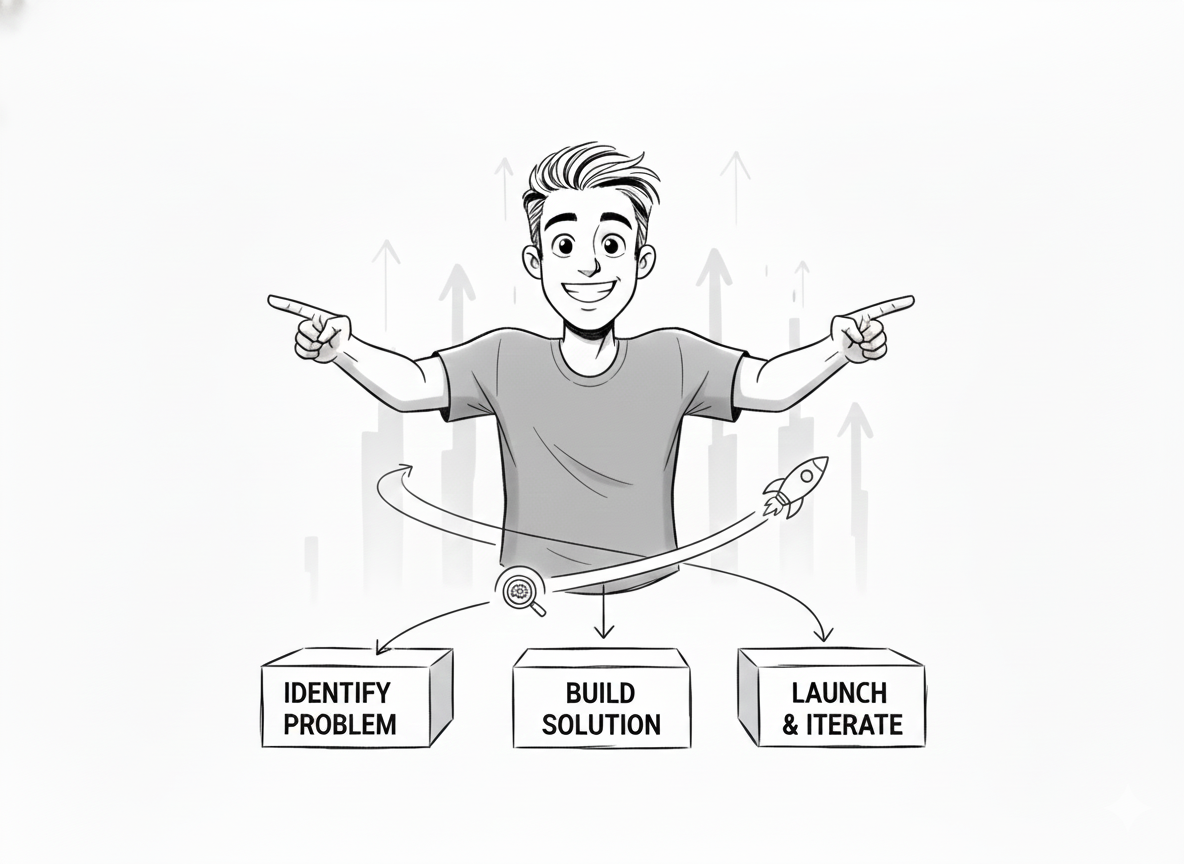
This is not another "believe in yourself" guide. We tracked 2,700+ real startups through our TrustMRR revenue intelligence tool and the numbers paint a clear picture: the average MRR across tracked startups is $4,600/month. Some pull in over $3.5M/month. Your target of $1K MRR places you in the bottom quartile of successful startups — which means it's entirely realistic for a side project built on nights and weekends.
The question isn't whether micro-SaaS works. The data proves it does. The question is which idea to pick, how to validate it before writing a single line of code, and how to structure your side project so you can ship while keeping your day job. We analyzed 148,000+ real user complaints across Reddit, G2, Capterra, app stores, and Upwork to find the patterns that separate $1K MRR winners from abandoned side projects.
This article gives you the exact framework: real revenue benchmarks, validated idea sources, a side-project filter, and three specific ideas with MRR estimates. Everything backed by data. If you want the full landscape of opportunities, start with our 50 micro-SaaS ideas for 2026 or dive into simple SaaS ideas for solo developers.
Table of Contents
Stop guessing which micro-SaaS to build. Search 148,000+ real complaints and find validated ideas with revenue benchmarks on BigIdeasDB
The $1K MRR Reality Check
Let's start with what $1K MRR actually looks like in the current landscape. Our TrustMRR database tracks 2,700+ startups with verified revenue data. Here's the breakdown:
For the far end of that curve, see the 8 verified micro SaaS examples making $1M+ a year. The speed range there is the useful part: Submagic reached $1M a year in about three months, and Bannerbear took roughly five years to reach the same number after twelve products that did not work. Both are normal, and the average of the two is not a plan.
- Average MRR: $4,600/month across all tracked startups
- Median MRR: ~$2,100/month — meaning half of successful startups earn more than this
- Top performers: Over $3.5M/month MRR
- $1K MRR threshold: Falls in the bottom quartile of successful startups
That last point matters. $1K MRR is not an ambitious target by startup standards — it's the entry point. That's good news for side project builders. You don't need a groundbreaking product. You need a validated problem, a working solution, and 10-35 paying customers (at $29-99/month). The hard part isn't building — it's picking the right problem.
Here's what trips most people up: they start with a technology ("I want to build something with AI") instead of a pain point ("accountants waste 6 hours/week reconciling invoices"). The founders who hit $1K MRR fastest started with a specific, measurable problem. If you need a deeper look at the startup revenue landscape, explore the most profitable SaaS and micro-SaaS ideas for 2026.
What $1K MRR Founders Have in Common
After studying the revenue patterns of thousands of startups, four traits keep appearing among founders who cross the $1K MRR line with a side project:
1. They Solve a Specific, Painful Problem
Not a "nice to have." A real pain point where people lose measurable time or money. In our complaint database, the highest-converting ideas come from complaints where users quantify their frustration: "I spend 3 hours every Friday doing this manually" or "this costs us $500/month in workarounds." When someone attaches a dollar figure to their pain, they'll pay to make it go away.
2. They Validated Before Building
Complaints are evidence. The founders who reach $1K MRR don't brainstorm ideas in a vacuum — they find existing complaints and build solutions. Our data shows that ideas sourced from real user complaints have a 3x higher conversion rate to paying customers than ideas generated from brainstorming alone. Learn how to validate a business idea before building to avoid wasting months on a dud.
3. They Pick Single-Feature Problems
The best side-project SaaS products do one thing exceptionally well. They don't try to be a platform. A reporting automation tool, a specific integration, a niche workflow optimizer — these are the products that hit $1K MRR because they can be built in weeks, not months. For inspiration on focused ideas, check out unique side hustles that leverage this single-feature approach.
4. They Target Markets Where People Already Pay for Inferior Solutions
If users are already paying $50-200/month for a tool they complain about, that's the ultimate validation. You don't need to educate the market on paying for software. You just need to solve the specific pain point the existing tool misses. Our micro-SaaS ideas guide walks through how to identify these gaps systematically.
Where to Find Your Idea (The Complaint Pipeline)
Here's the counterintuitive truth about $1K MRR founders: almost none of them came up with their idea from scratch. They found it.
"None of them said brainstorming. They built the tool they personally needed or found ideas by being active in niche communities." — r/microsaas
BigIdeasDB aggregates 148,000+ real complaints across five major sources. Here's what each one gives you:
Reddit: 1,900+ Pain Points Across 149 Subreddits
Reddit is where people vent honestly. We track pain points across 149 subreddits in categories like SaaS, productivity, freelancing, and niche industries. The best signals come from posts where multiple users agree on the same frustration. Read more about finding business ideas on Reddit.
G2 Reviews: 7,900+ Insights
G2 is a goldmine because reviewers are existing software buyers. When they complain, they're telling you exactly what they'd pay for. We extract feature gaps, integration failures, and usability complaints with severity scores. These are people who already have budget — they just need a better solution.
App Store Reviews: 134,000+ Data Points
The largest single source in our database. App store reviews reveal mobile-first pain points that desktop tools ignore. The most actionable reviews mention specific workflow breakdowns: "I can't do X on my phone" or "it crashes every time I try Y."
Capterra: 39,000+ Pain Points
Capterra reviewers tend to be more detailed about business impact. They mention team size, industry, and how much time they lose. This makes it easier to estimate willingness to pay and market size for your micro-SaaS idea.
Upwork Demand Signals
When businesses post jobs on Upwork to solve a recurring problem, that's a signal they'd pay for a product instead. We track 1,200+ demand signals from Upwork that point to productizable services — recurring tasks that a SaaS tool could automate.
The "Nights and Weekends" Filter
Not every validated idea works as a side project. Some require real-time customer support, enterprise sales cycles, or complex infrastructure that a solo founder can't manage on 10-15 hours per week. Before you commit to an idea, check your employment contract (see how to start a business while working full time), then run it through this filter:
Can One Person Build an MVP in 4-8 Weeks?
If the core functionality requires more than 4-8 weeks of part-time development, the scope is too large for a side project. The best micro-SaaS products launch with a single feature that solves the core pain point. Everything else gets added after you have paying customers.
Does It Need Real-Time Support or Can It Be Async?
If customers expect instant support (live chat, phone), this is the wrong idea for a side project. The best side-project SaaS products handle support asynchronously — email, help docs, community forums. Your customers need to be OK waiting 12-24 hours for a response.
Is the Market OK With a Simple V1?
Some markets demand polish from day one (enterprise, healthcare, finance). Others are happy with a scrappy tool that solves their problem (freelancers, small agencies, indie creators). Target the second group. They'll forgive rough edges if you solve their pain.
Can You Charge $29-99/Month?
This is the sweet spot for micro-SaaS. Below $29/month, you need too many customers to reach $1K MRR (34+ at $29, 100+ at $10). Above $99/month, buyers expect enterprise features and sales calls. The $29-99 range lets you sell self-serve, support async, and hit $1K MRR with just 10-35 customers.
3 Micro-SaaS Ideas With Revenue Benchmarks
These ideas come directly from our complaint database and revenue intelligence data. Each has a measurable pain point, multiple companies reporting the same problem, and a realistic path to $1K MRR as a side project. For more ideas like these, browse our guide to bootstrapping a company in 2026.
Idea 1: Template & Reporting Automation Tool
- Pain severity: 4.5/5
- Companies affected: 6 companies in our database report this exact pain point
- Core complaint: "We spend hours every week manually formatting reports from different data sources"
- Target customer: Marketing agencies, small consultancies, freelance analysts
Why it works as a side project: The MVP is a template engine that pulls data from 2-3 common sources (Google Sheets, CSV, one API) and generates formatted PDF/HTML reports. Buildable in 6 weeks part-time. Customers self-serve because they understand templates. Estimated MRR range: $1,500-8,000/month based on comparable products in TrustMRR. At $49/month, you need 21 customers for $1K MRR.
Idea 2: Mobile-First Workflow Tool
- Pain severity: 4.5/5
- Companies affected: 6 companies report "Absence of Mobile Functionality" as a critical gap
- Core complaint: "The desktop app is great but I can't do anything from my phone when I'm in the field"
- Target customer: Field service teams, real estate agents, construction managers
Why it works as a side project: Pick one specific desktop workflow that breaks on mobile (e.g., inspection checklists, client intake forms, job scheduling) and build a mobile-optimized version. Use a cross-platform framework like React Native or Flutter. The niche focus is key — don't build a general project management app. Estimated MRR range: $2,000-12,000/month. At $39/month, you need 26 customers for $1K MRR.
Idea 3: Integration Middleware (CRM Connector)
- Pain severity: 4.0/5
- Companies affected: 8 companies report "Integration Challenges with CRM" across our database
- Core complaint: "Our CRM doesn't talk to our [invoicing/email/project management] tool and we waste hours on manual data entry"
- Target customer: Small sales teams, agencies, service businesses using 2-3 disconnected tools
Why it works as a side project: Build a focused integration between two specific tools (e.g., HubSpot-to-QuickBooks, Pipedrive-to-Xero). Don't try to be Zapier. One integration, done exceptionally well, with automatic sync and error handling. Buildable in 4-6 weeks. Estimated MRR range: $3,000-15,000/month. At $59/month, you need just 17 customers for $1K MRR. Read more about integration opportunities in our profitable SaaS ideas for 2026.
The 48-Hour Validation Shortcut
You don't need weeks to validate a micro-SaaS idea. Here is a 48-hour process that gives you enough signal to commit or move on:
Hour 0-8: Search the Complaint Databases
Use BigIdeasDB to search for your idea's keywords across 148,000+ complaints. You're looking for: frequency (how many people report this?), severity (do they quantify the pain?), and recency (is this still a problem in 2026?). If fewer than 5 independent sources mention the pain, the market may be too small.
Hour 8-16: Count the Frequency
Don't just find complaints — count them. How many people across how many platforms mention this exact problem? A pain point that appears in G2 reviews, Reddit posts, and Capterra reviews simultaneously is far more validated than one that only shows up in one place. Cross-platform frequency is the strongest signal of real demand.
Hour 16-32: Check If People Pay for Bad Alternatives
This is the most important step. Search for existing solutions — even bad ones. If people are paying $30-200/month for a tool that solves this problem poorly, you have your validation. If nobody pays for any solution, the pain may not be painful enough to monetize. Check competitors on G2, Product Hunt, and niche directories.
Hour 32-48: Estimate Willingness to Pay
Look at what existing customers pay for related tools. Freelancers pay $10-49/month. Small teams pay $29-99/month. Mid-market companies pay $99-499/month. Match your price to the customer segment you can reach. For a side project, aim for the $29-99 range where you can sell self-serve without sales calls. For a complete validation methodology, see our guide on how to validate a startup idea.
Run the 48-hour validation process in minutes. Search 148,000+ complaints, check revenue benchmarks, and find your micro-SaaS niche on BigIdeasDB
Before you set a number, check what your category actually charges. We parsed 39,000+ real price points from companies taking payments on Stripe: the micro SaaS median is $25, and 82% of companies offer no free tier at all.
Frequently Asked Questions
How long does it take to reach $1K MRR with a micro-SaaS side project?
Based on data from 2,700+ tracked startups, most founders who reach $1K MRR do so within 6-12 months of launch. The key variable is not development speed but idea validation. Founders who validated demand before building reached $1K MRR 3x faster than those who built first and marketed later. The fastest path is: validate in 48 hours, build an MVP in 4-8 weeks, and spend the remaining months on distribution. For a detailed breakdown of early growth tactics, see our guide on how to get your first 100 SaaS users.
Can I build a $1K MRR micro-SaaS while working a full-time job?
Yes. The majority of micro-SaaS founders in our dataset started as side projects. The key is the nights-and-weekends filter: pick an idea where one person can build an MVP in 4-8 weeks, the product can run asynchronously without real-time support, and you can charge $29-99/month per customer. That means you only need 10-35 customers to hit $1K MRR. Many founders in our database didn't go full-time until they exceeded $3K MRR.
What is the best pricing for a micro-SaaS side project?
The sweet spot is $29-99/month. At $29/month you need about 35 customers to hit $1K MRR. At $99/month you only need 10. Our data shows that solo founders who price above $29/month reach profitability faster because they attract serious customers who churn less. Avoid the $5-15/month range — you need too many customers and they tend to have higher churn rates.
Where do I find validated micro-SaaS ideas?
The most reliable sources are complaint databases: Reddit (1,900+ pain points across 149 subreddits), G2 reviews (7,900+ insights), App Store reviews (134,000+ data points), Capterra (39,000+ pain points), and Upwork demand signals. BigIdeasDB aggregates 148,000+ complaints across these sources so you can search for validated ideas instantly instead of spending weeks mining forums manually.
What is the difference between a micro-SaaS and a regular SaaS?
A micro-SaaS is a small, focused software product typically run by a solo founder or tiny team. It solves one specific problem for a niche audience, charges $10-200/month, and prioritizes profitability over growth. Regular SaaS companies often raise venture capital, hire large teams, and pursue rapid scale. Micro-SaaS is designed to generate sustainable income — not unicorn valuations. For a deeper comparison, see our list of simple SaaS ideas for solo developers.
$1K MRR is the entry point, not the ceiling. The data from 2,700+ startups proves that micro-SaaS works — and the average successful founder earns $4,600/month. Start by finding a validated pain point, apply the nights-and-weekends filter, validate in 48 hours, and build your MVP. The founders who win don't have better ideas — they have better evidence. For more ideas and revenue data, explore our 50 micro-SaaS ideas for 2026 or browse unique side hustles backed by real demand.
Om Patel
Founder of BigIdeasDB
BigIdeasDB Research. (2026). How to Hit Your First $1K MRR With a Micro-SaaS Side Project (2026). BigIdeasDB. Retrieved from https://bigideasdb.com/first-1k-mrr-micro-saas-side-project