Funded DB: A Searchable Database of 17,000+ VC-Backed Startups
TLDR
Funded DB is a searchable database of more than 17,000 startups backed by a dozen-plus of the world's top VCs and accelerators, with an AI investment analysis on nearly all of them. Each company carries an investment-attractiveness score, a momentum score, a growth stage, an AI thesis and risk flags across 100+ sectors. Instead of guessing what to build, you read what the smartest money already validated, find the white space inside it, and build the better-executed version. Below: what is inside the dataset, how the AI scoring works, a beta user success story, and the four-step workflow to turn it into your next idea. See the Funded DB feature page or jump straight into the live database.
Finding a startup idea is not the hard part. Finding one that someone will actually pay for is. Most founders start from a blank page, brainstorm in a vacuum, and only discover whether the market exists after they have spent three months building. There is a faster way: start from markets that sophisticated investors have already put money behind, then build into the gaps they left open.
That is the entire idea behind Funded DB. Every company a top VC or accelerator funds is a market thesis with real capital behind it. One funded company is a data point. Seventeen thousand of them, tagged and scored, is a map. Funded DB turns that map into something you can search, filter, and chat with in seconds.
This is a guide to the feature: what is in it, how the AI scoring works, and how real users turn it into a buildable idea. The dataset grows continuously, so the figures below are approximate snapshots, not fixed counts. For the broader market read, pair it with our analysis of what VCs are funding in 2026.
Table of Contents
- What Funded DB actually is
- What is inside the dataset
- How the AI scoring works (including what NOT to build)
- The research chat: ask the data directly
- Beta user success story: from blank page to first paying users
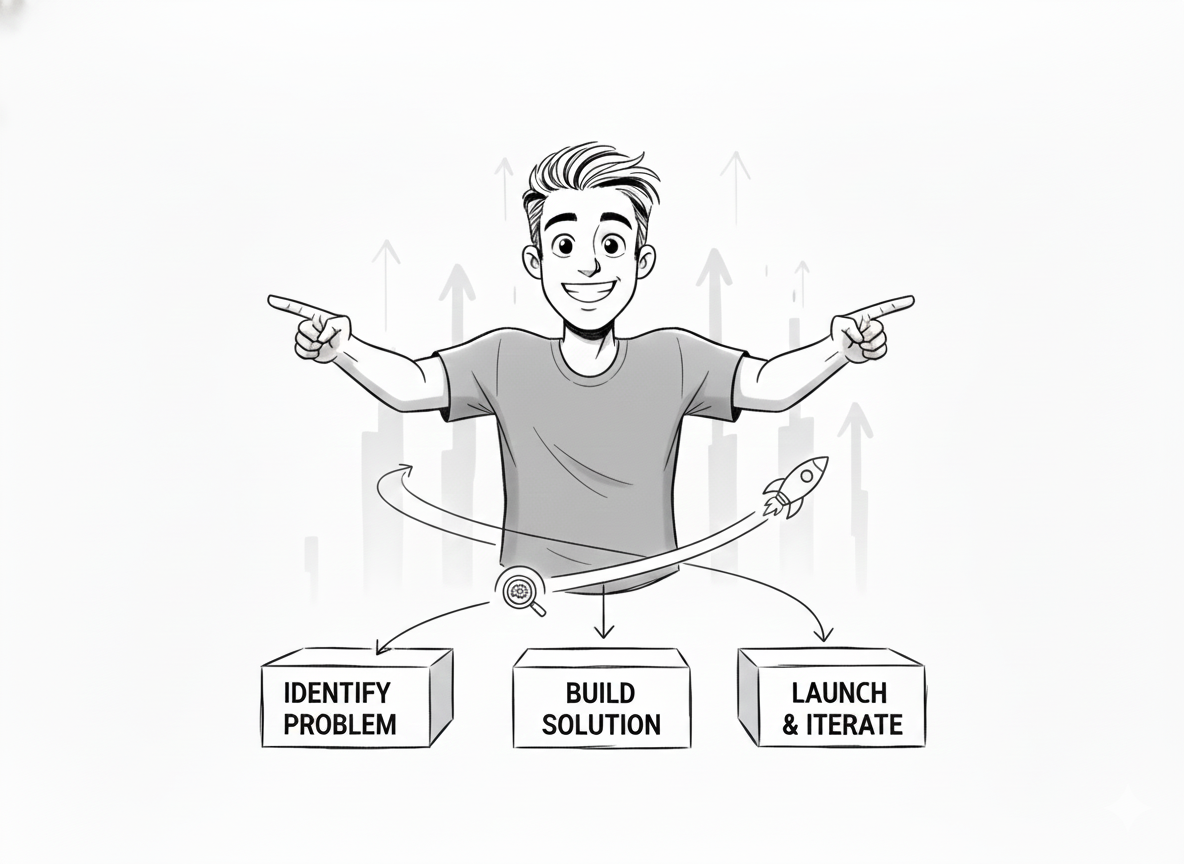
- How to use Funded DB in four steps
- Why this beats a raw YC or Crunchbase list
- Frequently Asked Questions
Want to see what the best VCs are quietly backing, by sector and by firm? BigIdeasDB's Funded DB maps thousands of portfolio companies with an AI investment thesis on each one, fully searchable and chattable.
What Funded DB actually is
Funded DB is a searchable database of more than 17,000 startups backed by a dozen-plus of the world's most respected investors. It covers the two funding models that matter: accelerators that write small checks across huge cohorts, and concentrated VC firms that write larger checks into fewer, later-stage companies. The tracked investors include Y Combinator, Techstars, 500 Global, Andreessen Horowitz, Sequoia Capital, Lightspeed Venture Partners, Bessemer Venture Partners, New Enterprise Associates, Accel, Antler, First Round Capital, Index Ventures, Insight Partners, General Catalyst and DMZ.
What makes it more than a list is the AI layer. Each company is analyzed and scored so you are not reading raw names, you are reading graded opportunities. You can search by keyword, filter by sector or stage, sort by momentum, open any company's investment thesis, or simply ask the research chat a question and get a cited answer. It is the same workflow we describe in how to find startup ideas that get funded, packaged into one tool.
What is inside the dataset
The headline numbers, refreshed live and always growing:
- 17,000+ funded companies across the full portfolio of a dozen-plus top investors.
- AI analysis on nearly all of them — scores, theses and risk flags on virtually every company.
- 100+ distinct category tags, from fintech and devtools to climate tech and agtech.
- A dozen-plus tracked investors spanning accelerators and tier-one VC firms.
- Real, recognizable companies. Anthropic, Stripe, Databricks, Scale AI, ElevenLabs, Perplexity, Cloudflare, Plaid and Flutterwave all sit in the dataset alongside thousands of earlier-stage bets.
The sector mix is where the map gets useful. By company count the biggest funded categories are B2B SaaS (4,000+), consumer (2,800+), fintech (2,200+), healthcare (2,000+), AI infrastructure (1,700+) and developer tools (1,300+). But count is not the same as momentum. Rank the companies funded in the last 18 months by their AI momentum score and the order flips: cybersecurity and security lead, followed by AI infrastructure and developer tools, then fintech. The biggest market and the fastest-accelerating market are not the same place, and Funded DB lets you see both. We track how that shifts over time in our 2026 startup funding trends report.
How the AI scoring works (including what NOT to build)
Every company in Funded DB is graded on two scores that do most of the work:
- Investment attractiveness (1-10) — how compelling the opportunity looks on fundamentals.
- Momentum (1-10) — how fast the company and its market appear to be accelerating.
On top of those, each profile carries a category tag, a business-model tag, a target customer, a growth stage, a plain-English AI summary, an AI investment thesis and a set of risk signals. The growth stage is the part founders underuse. It does not just label winners, it labels failures. Across the dataset, companies tagged dead score near the rock bottom of the attractiveness scale, while companies in the growth stage score more than twice as high. That spread is a gift: you learn what not to build as clearly as what to build.
The stage distribution tells its own story about survivorship: the largest share of companies are still at MVP, with thousands more spread across early traction, growth and mature, hundreds already exited, and a substantial pile flagged as dead. When you study a sector, you are not just seeing the success stories that survived, you are seeing the graveyard too. That is the difference between a highlight reel and real market intelligence.
The research chat: ask the data directly
You do not have to scroll thousands of rows. Funded DB ships with a research chat that answers questions against the dataset with citations. Ask "which firms are crowding into fintech infrastructure?" or "what has YC funded in healthcare in the last year?" or "show me high-momentum devtools with a small team," and it returns a cited answer in seconds instead of an afternoon of manual filtering. Open the research chat to try it. It is the same conversational layer that powers our revenue intelligence tool, pointed at funded portfolios.
Beta user success story: from blank page to first paying users
Here is how a Funded DB beta user went from no idea to first paying customers. The story below is a representative walkthrough of the workflow our early-access founders followed, with identifying details removed.
A bootstrapped founder with a background in finance operations wanted to start a B2B SaaS but had no specific idea, only a strong domain. She started in Funded DB by filtering to the fintech category and sorting by momentum. Instead of chasing the obvious crowded lanes (consumer neobanks, crypto wallets), she read the AI theses on the high-attractiveness, high-momentum companies and noticed a pattern: a cluster of funded startups were solving payments and reconciliation for larger enterprises, but the AI risk flags repeatedly noted the same gap — the underserved small-business segment underneath them.
"I stopped trying to invent something nobody had funded. The theses showed me a market a dozen investors already believed in, and the risk flags showed me exactly who those companies were ignoring. That gap was my product."
— representative Funded DB beta user
From there she triangulated. She cross-checked the gap against BigIdeasDB's complaint data to confirm small-business owners were actively frustrated with manual reconciliation, then checked revenue benchmarks to confirm the category could support a real price. Three independent signals lined up: capital was flowing into the market, humans were complaining about the exact problem, and comparable tools were already making money. That convergence is the whole point of researching across sources rather than trusting one.
She shipped a narrow MVP in a few weeks, took it to the communities where those complaints lived, and converted her first paying users inside the first month. The build was fast because the hard question, "does anyone want this," was answered before she wrote a line of code. If you want the same validation discipline, our help guides on how to find SaaS ideas and the SaaS idea validation tool walk through the full workflow.
How to use Funded DB in four steps
The workflow that beta user followed generalizes. Here is the repeatable version:
- 1. Pick a funded sector with proven economics. Start where capital concentrates and the unit economics are known: B2B SaaS, fintech and healthcare lead by company count.
- 2. Read the theses and risk flags, not just the names. The white space lives in the gaps the AI risk signals keep repeating across funded companies in that sector.
- 3. Triangulate before you build. Confirm the gap against real complaints, validated demand, and revenue benchmarks. Three independent signals beat one.
- 4. Build the better-executed version. Investors already validated the market. Your edge is execution on the segment, geography, or workflow they underserve.
This works whether or not you ever raise. If you would rather not take venture money, the same map guides a bootstrapped build into a proven market, which is exactly the approach we lay out in bootstrapping a company in 2026. And if you want a curated shortlist to start from, our best AI business ideas for 2026 are ranked using this exact dataset.
Stop brainstorming in a vacuum. Find a market the smartest money already validated, then build into the gap. BigIdeasDB puts Funded DB, 1M+ real complaints, validated demand, and revenue benchmarks in one place.
Why this beats a raw YC or Crunchbase list
A raw list of funded companies tells you who got money. It does not tell you what to do about it. Funded DB adds three things a plain list cannot:
- An AI thesis and scores on every company — so you read graded opportunities, not undifferentiated names.
- A research chat with citations — so you ask questions instead of scrolling spreadsheets.
- Cross-source triangulation — funded signal sits next to 1M+ complaints, validated swipe rates, and real revenue benchmarks, so you can confirm a market three ways before committing. That is the same evidence stack behind our SaaS revenue benchmarks.
Funding is a signal, not a guarantee. Plenty of funded companies sit in the dead pile. So treat Funded DB as the first filter, then confirm with demand and revenue data before you build. Browse the full database in Funded DB, or read the feature overview to see how it all fits together.
Frequently Asked Questions
What is Funded DB?
Funded DB is a searchable database of more than 17,000 startups backed by a dozen-plus of the world's top VC firms and accelerators, including Y Combinator, Techstars, Andreessen Horowitz, Sequoia, Lightspeed and Accel. Each company carries an AI analysis with an investment-attractiveness score (1-10), a momentum score (1-10), a category tag, a growth stage, an investment thesis and risk flags. Founders use it to find validated markets to build into instead of guessing.
How many companies and investors does Funded DB cover?
Funded DB tracks more than 17,000 funded companies across a dozen-plus top investors and 100+ distinct category tags, with an AI investment analysis on nearly all of them. The dataset grows continuously as new rounds are added. Coverage spans accelerators that write small checks across large cohorts (Y Combinator, Techstars, 500 Global) and concentrated VC firms (a16z, Sequoia, Insight Partners, Accel, Lightspeed, Bessemer).
How does the Funded DB AI scoring work?
Every company is scored on investment attractiveness (1-10) and momentum (1-10), then tagged with a category, business model, target customer and growth stage. The growth stage even flags companies as dead, which score near the bottom of the attractiveness scale, so you learn what not to build as clearly as what to build. Each profile also includes an AI summary, an investment thesis and risk signals.
How is Funded DB different from a list of YC or Crunchbase companies?
A raw list tells you who got funded. Funded DB tells you what to do about it. It adds an AI investment thesis and scores on top of each company, lets you search and filter by sector, momentum and stage, and includes a research chat that answers questions with citations. You can also triangulate a market against BigIdeasDB's 1M+ complaints, validated swipe rates and real revenue benchmarks in one place.
Can bootstrappers use Funded DB, or is it only for VC-backed founders?
Both. Funded portfolios are a map of markets that sophisticated investors already validated. Bootstrappers use that map to build into proven demand without raising money, picking the white space a funded company underserves and out-executing on it. The same data that guides a fundraise guides a bootstrapped build. Start in Funded DB and validate with the SaaS idea validation tool.
Written by Om Patel, founder of BigIdeasDB. Data sourced live from Funded DB's analysis of 17,000+ VC- and accelerator-backed companies, a dataset that grows continuously. The beta user story is a representative, anonymized walkthrough of the Funded DB research workflow. Share on X.
BigIdeasDB Research. (2026). Funded DB: A Searchable Database of 17,000+ VC-Backed Startups. BigIdeasDB. Retrieved from https://bigideasdb.com/funded-startups-database