How to Build a SaaS in 2026: A Data-Backed Step-by-Step Guide
Most guides on how to build a SaaS skip the one number that matters most. So here it is up front: across 3,478 tracked startups in our revenue database, the median SaaS earns about $7 in monthly recurring revenue. Not $7,000. Seven dollars. The gap between that median and the handful of products doing real money is almost never about the code — it's about what got built and whether anyone needed it.
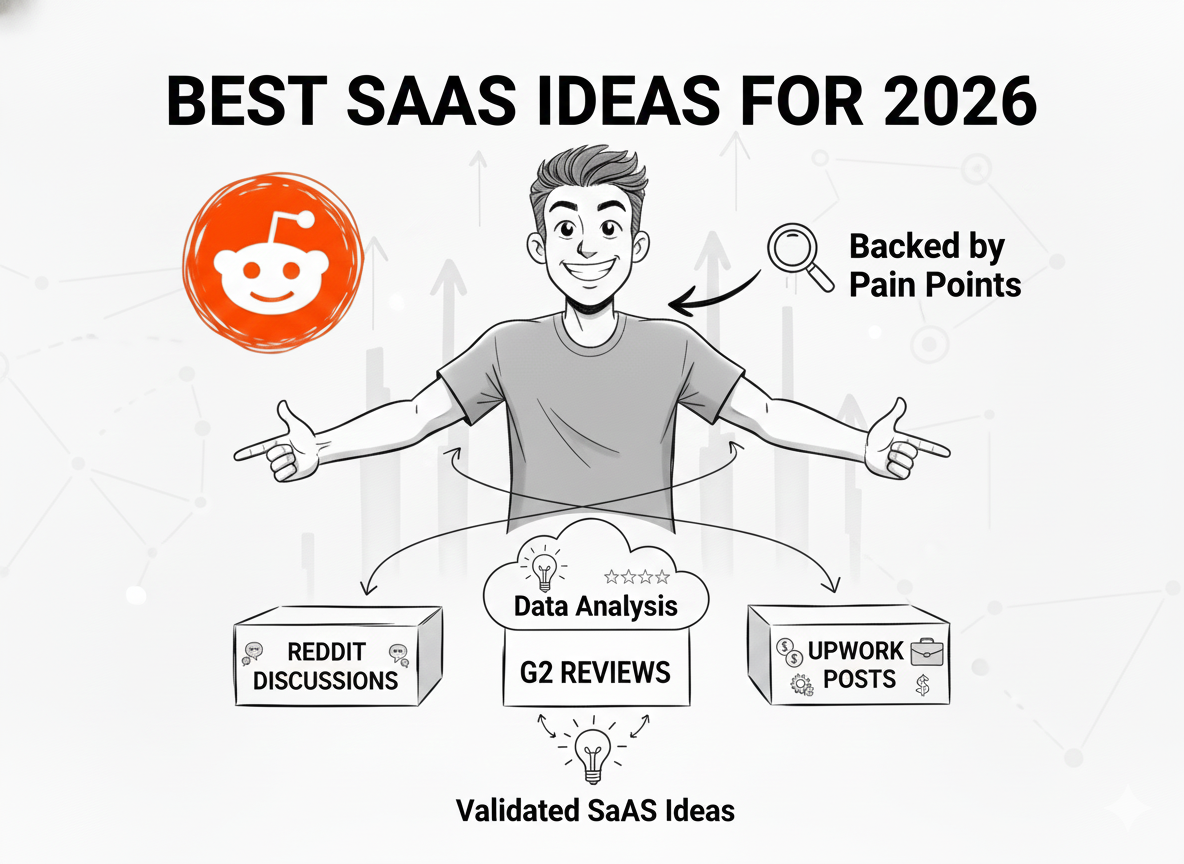
This guide is the opposite of the "spin up a Next.js app and add Stripe" tutorials. It's a sequence built from real data: 1M+ analyzed complaints across Reddit, G2, Capterra, and the app stores, revenue benchmarks from thousands of live startups, and the unfiltered accounts of founders who shared exactly where they went wrong. Follow it in order and you build the right thing. Skip to the build step — like most people do — and you join the $7 median.
"Building my SaaS felt productive until I realized nobody actually needed it. A lot of it was me avoiding uncomfortable feedback." — r/SaaS
Table of Contents
- 1. The data: why most SaaS products fail before launch
- 2. Step 1 — Start from a documented complaint, not an idea
- 3. Step 2 — Pick a category with proven revenue
- 4. Step 3 — Talk to 10 people before you write code
- 5. Step 4 — Choose the simplest stack (code or no-code)
- 6. Step 5 — Build the narrowest possible MVP
- 7. Step 6 — Charge from day one
- 8. Step 7 — Spend more time on distribution than code
- 9. How long it takes and what it costs
- 10. The 5 mistakes that kill first-time SaaS builders
- 11. FAQ
Before you build anything, see the validated problems people are already complaining about — sorted by severity and market gap on BigIdeasDB.
The data: why most SaaS products fail before launch
Building a SaaS has never been cheaper or faster. That's precisely the problem. When shipping is easy, the bottleneck moves entirely to deciding what to ship, and that's where almost everyone fails. Here's what the numbers say across our revenue database of 3,478 tracked startups:
- Median MRR is ~$7. Most SaaS products make effectively nothing — not because the founders couldn't code, but because they built for a problem nobody was paying to solve.
- The AI category is the most crowded. It's the single largest segment with 1,213 tracked startups growing an average of 99.9% year over year — yet the median AI startup still makes about $7 MRR because most are thin "ChatGPT for X" wrappers.
- Margins are extraordinary when it works. Developer Tools average 76.8% profit margins, mobile micro-SaaS 79.5%, and Education 72.9%. SaaS is the highest-margin business you can bootstrap — once you find the signal.
The takeaway isn't "don't build a SaaS." It's that the build is the easy 20%. The seven steps below put the hard 80% — proving the problem is real — before the part that feels productive. If you only remember one thing: validate the idea before you write a line of code.
Step 1 — Start from a documented complaint, not an idea
Every founder guide says "solve a real problem." None of them tell you where to find one. The answer: stop brainstorming and start reading complaints. People document their most painful, recurring problems for free, every day, on Reddit, in G2 and Capterra reviews, and in one-star app store ratings. Those complaints are demand evidence you can read before building anything.
A strong SaaS opportunity has four signals you can verify in the data: high frequency (lots of people raise it), high pain intensity (4+ out of 5), a quantified cost (hours or dollars lost), and weak existing solutions. For example, our pre-scored opportunity set flags a fast-response support & integration tool for niche software at an 8.7/10 opportunity score — roughly 30% of companies report support response times that are too slow, and incumbents consistently fail at it. That's a documented gap, not a hunch.
"Just wasted 2 months building something nobody wanted. Revenue: $0. Sign-ups: 23 (19 were bots). Paying customers: 0." — r/SaaS
If you can't find anyone complaining about the problem online, that's not an untapped market — it's a signal there is no market. Start your search where the pain is already written down. Our guide on finding business ideas on Reddit and the best SaaS ideas backed by pain points both walk through how to read these signals.
Step 2 — Pick a category with proven revenue
Not all SaaS categories pay the same. Here's how the largest segments in our revenue database actually perform — average MRR, growth, and profit margin across thousands of live startups:
| Category | Tracked startups | Avg MRR | Avg growth | Avg margin |
|---|---|---|---|---|
| Content Creation | 231 | $15,921 | 29.7% | 65.9% |
| Analytics | 139 | $3,066 | 78.0% | 62.8% |
| Marketing | 255 | $2,535 | 67.6% | 68.1% |
| Artificial Intelligence | 1,213 | $1,746 | 99.9% | 63.4% |
| Developer Tools | 332 | $319 | 90.6% | 76.8% |
Two lessons hide in this table. First, high average MRR (Content Creation, Analytics) tends to come with lower growth — these are mature markets. Second, the AI category's 99.9% average growth is real, but so is its crowding; you win there by going vertical (AI for one documented industry workflow), not general. For deeper category breakdowns, see the most profitable SaaS niches for 2026 and validated micro-SaaS ideas.
Step 3 — Talk to 10 people before you write code
A documented complaint tells you the problem exists. Conversations tell you whether people will pay you to fix it. Find 10 people who have the exact problem — the complaint threads from Step 1 are full of them — and ask how they handle it today, what it costs them, and what they've already tried to buy. You're listening for one thing: a workaround so painful they'd pay to delete it.
"Validation was a lot easier than building." — r/SaaS
This is the step founders skip because it's uncomfortable and doesn't feel like progress. It is the highest-leverage hour you'll spend. Our guide to validating before building gives you the exact questions, and the startup idea validation checklist turns it into a repeatable process.
Write down what you hear somewhere more useful than a scattered notes app — a Notion alternative for developers built on BuildHub's Infinity Canvas turns those ten conversations directly into a visual spec you can build from, instead of a doc nobody reopens.
Step 4 — Choose the simplest stack (code or no-code)
In 2026 you have three realistic paths to build a SaaS: full-code (Next.js + Supabase/Postgres + Stripe), AI-assisted code (Cursor, Claude, v0), or no-code (Bubble, Softr, Glide). The right answer is whichever lets you ship a working version fastest. None of them is a moat — the moat is the validated problem you found in Steps 1–3.
A caution on AI coding: it accelerates the start and can quietly cost you the middle. A founder on r/SaaS put it bluntly:
"ChatGPT forgot what came before and gave me code that completely messed up the existing stuff. 3 days I had to spend fixing the damage." — r/SaaS
Use AI to move fast, but keep the architecture small enough that you understand it. If you're non-technical, no-code is a perfectly valid way to get to revenue — see our SaaS ideas for non-technical founders and the deeper walkthrough on building SaaS with Cursor and Claude. If your vibe-coded MVP is buckling, here's when to bring in a developer.
Whatever stack you land on, you still need somewhere to plan and track the build itself — tasks, specs, the rough architecture. With Height.app now shut down, a lot of small teams have moved to BuildHub's visual canvas as a Height.app alternative for exactly this kind of project planning.
Step 5 — Build the narrowest possible MVP
Your MVP should do one painful job completely, not ten jobs partially. The winners in our data are vertical tools that fix a specific, documented complaint — "automated VAT calculation for invoices," "real-time inventory sync between physical and e-commerce stock," "custom reporting for church finances" — not another general-purpose dashboard. Narrow is what makes you findable, describable, and worth paying for.
"We followed the classic MVP playbook, building and launching in just two weeks. It was functionally basic and, frankly, looked terrible. But it worked." — r/SaaS
Resist the urge to add features instead of fixing the core. One founder learned this the expensive way: "I had a dashboard that was slow and buggy, but instead of fixing it, I kept adding new features because it felt more productive. I lost more customers to a slow dashboard than I ever gained from a new feature." — r/SaaS. Ship the one thing, make it work, then talk to users again.
Before you open your editor, it helps to sketch the shape of that one job first — a Miro alternative for software projects lets you map how the MVP's pieces fit together visually, so the narrow scope stays narrow once you actually start coding.
Want the narrow, painful jobs spelled out for you? BigIdeasDB surfaces 3,200+ pre-scored SaaS opportunities — each tied to real complaints, with a market-gap score and the exact problem statement.
Step 6 — Charge from day one
Free users are not validation. A credit card is. Charge from the first version, even if the price is low and the product is rough — payment is the only signal that separates "interesting" from "I need this." A founder captured the moment perfectly:
"Not signups. Not 'interested' users. Actual payments. It's not life-changing money. But it's proof." — r/SaaS
On pricing: most successful bootstrapped SaaS lands in the $15–$99/month range for individual tools and higher for team products. Don't over-engineer tiers early — start with one or two plans and adjust as you learn. For a deeper framework, see our SaaS pricing strategies for 2026 and the revenue reality check across real SaaS revenue benchmarks.
Step 7 — Spend more time on distribution than code
This is the step that decides whether you join the $7 median. The single most common refrain from founders who built a good product and still failed is that they had no plan to reach anyone:
"Building my SaaS took 3 weeks. Getting my first 50 paying customers took 5 months. Distribution ate me alive." — r/SaaS
Building is finite; distribution is the job. Plan it from day one, not after launch. Because it's the make-or-break phase, we've given it two dedicated guides: read how to get your first customer for the zero-to-one moment, then how to get customers for a startup for repeatable acquisition. For SaaS specifically, our breakdown of getting your first 100 SaaS users and where to launch your startup cover the channels that actually convert.
How long it takes and what it costs
Two honest numbers to set expectations:
- Build time: 2–4 weeks for a narrow MVP if you keep scope ruthless. Founders routinely ship in two weeks; the ones who take six months are usually adding features to avoid distribution.
- Cost: under $500 in tooling for a bootstrapped MVP. The real cost is time. With 60–80% margins typical across tracked SaaS, the unit economics are forgiving once revenue starts — getting to revenue is the hard part.
- Time to first customer: weeks to months. Expect distribution to take longer than the build. If you priced and talked to users early (Steps 3 and 6), you'll get there far faster.
One more reality check on quitting your job: "I resigned from my full-time job too early... I only had savings for three months, and growing a SaaS business wasn't as linear as I'd imagined." — r/SaaS. Build alongside income until revenue is real. For the full bootstrapped playbook, read bootstrapping a company in 2026.
The 5 mistakes that kill first-time SaaS builders
- Building before validating. The $7 median is built on this. Read complaints and talk to 10 people first.
- Building too broad. Ten half-jobs lose to one complete job. Narrow wins.
- Adding features instead of fixing the core. Speed and reliability keep customers; new features rarely win them.
- Not charging early. Free signups feel good and prove nothing. Payment is the only validation.
- No distribution plan. "I have built a SaaS as well and I have no idea how to market it. The hardest part is distribution, not building the tool." — r/SaaS. Plan it before you launch.
Frequently Asked Questions
How do I build a SaaS from scratch in 2026?
Build it in seven steps: find a documented complaint, pick a category with proven revenue, talk to 10 people who have the problem, choose the simplest stack, build the narrowest MVP, charge from day one, and spend more time on distribution than code. The order is the whole point — across 3,478 tracked startups the median SaaS earns ~$7 MRR, and the ones earning nothing almost always built before validating.
Can I build a SaaS without coding?
Yes — no-code tools (Bubble, Softr, Glide) and AI coding assistants let non-technical founders ship a working MVP. But building is rarely the hard part; distribution is. Validate demand against real complaints before spending a dollar on the build, no-code or otherwise.
How much does it cost to build a SaaS?
A bootstrapped MVP can be built for under $500 in tooling because the real cost is your time. Software businesses average 60–80% profit margins in our data (Developer Tools 76.8%, mobile micro-SaaS 79.5%), which is why SaaS stays the highest-margin business you can bootstrap. The expensive mistake is months spent building something unvalidated.
How long does it take to build a SaaS?
A focused MVP can ship in 2–4 weeks if you keep scope to a single painful job. Getting from launch to revenue typically takes several more months of distribution work — the part most guides skip.
What is the biggest mistake when building a SaaS?
Building before validating. As one founder put it on r/SaaS: "Just wasted 2 months building something nobody wanted. Revenue: $0. Sign-ups: 23 (19 were bots). Paying customers: 0." Building feels productive, which is exactly why it's the comfortable way to avoid confirming the problem is real.
Don't build on a guess. BigIdeasDB analyzes 1M+ real complaints across Reddit, G2, Capterra, and the app stores so you build the one thing people are already paying to fix.
Written by Om Patel. Data sourced from BigIdeasDB's analysis of 1M+ complaints across Reddit, G2, Capterra, and the Apple and Google app stores, plus revenue benchmarks from 3,478 tracked startups. Share this article on X.
BigIdeasDB Research. (2026). How to Build a SaaS in 2026: A Data-Backed Step-by-Step Guide. BigIdeasDB. Retrieved from https://bigideasdb.com/how-to-build-a-saas-2026